Garage Door Remote Not Working? Fixes to Try First
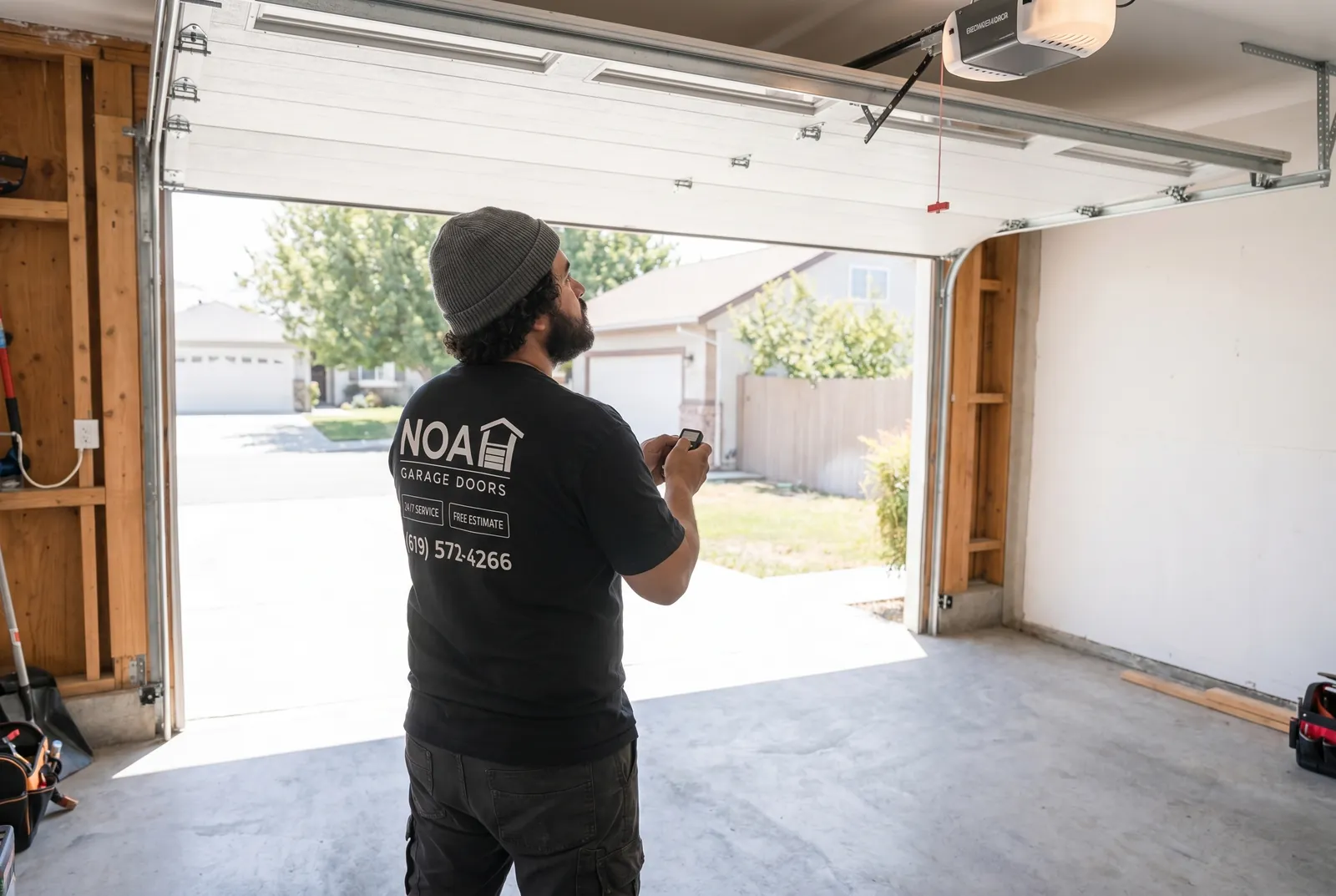
If your garage door remote isn't working, start with the battery: a dead battery causes the majority of remote failures. If a fresh battery doesn't help, test the wall button, rule out signal interference, and reprogram the remote. If none of that works, a universal replacement remote (around $20 to $40) is usually the next step before calling a technician.
A garage door remote that suddenly stops working is one of the most common calls we get from San Diego homeowners. One moment it's fine, the next you're pressing the button and nothing happens. The frustrating part is that it can be something as trivial as a dead battery or as involved as a failing receiver board. This guide walks you through every fix to try, in order, so you're not calling a technician for a $5 battery swap.
Whether you're in Mission Valley, Mira Mesa, or out in Santee, the diagnostic steps are the same. Work through them in sequence before reaching out for garage door opener repair, and you may resolve the issue in under five minutes.
Step 1: Replace the Battery First
This sounds obvious, but it accounts for the majority of remote failures we see. San Diego's temperature swings, particularly in inland communities like El Cajon and Lakeside where summer heat regularly tops 95 degrees, drain batteries faster than the national average. Most remotes use a CR2032 coin cell or a 9-volt, depending on the brand.
- Open the back of the remote (usually a small Phillips screw or a sliding tab).
- Note the battery type and voltage printed inside.
- Replace with a fresh battery from a reliable brand, not a decade-old spare from the junk drawer.
- Test the remote from different distances: close, mid-range, and the end of your driveway.
If the remote still doesn't respond after a fresh battery, move to Step 2.
Step 2: Test the Wall Button
Walk into the garage and press the hardwired wall button. If the door opens and closes normally, the opener unit itself is working fine. That narrows the problem to either the remote or the opener's radio receiver. If the wall button also fails to trigger the door, the problem is upstream, such as a power outage, a tripped breaker, or a fault in the opener motor. Check that the opener is plugged in and that the circuit breaker hasn't tripped.
Step 3: Check for Signal Interference
Modern garage door remotes operate on radio frequencies around 315 MHz or 390 MHz. Several things in and around San Diego homes can interfere with that signal:
- LED bulbs in the opener housing. Certain LED bulbs emit radio frequency noise that blocks the receiver. Swap to an incandescent or a garage-door-rated LED bulb.
- Nearby electronics. Smart home hubs, baby monitors, and some wireless routers can interfere, especially in densely built neighborhoods like Clairemont or Pacific Beach.
- New construction or metal fencing. If a metal structure recently went up near your garage, it may be attenuating the signal.
- Damaged antenna wire. The opener has a thin wire antenna hanging from the motor head. Make sure it hangs straight down and is not coiled or stapled against metal.
Step 4: Reprogram the Remote
If interference is ruled out, the remote may have lost its pairing with the opener. This happens occasionally after power surges or when someone accidentally holds the Learn button on the opener. Here is the general process for most major brands:
- Locate the Learn button on the opener motor head (usually a small colored button near the antenna wire).
- Press and release it once. The LED next to it will light up for about 30 seconds.
- Within those 30 seconds, press and hold the button on your remote until the opener's light flashes or you hear two clicks, confirming the new code is stored.
- Test the remote. Repeat for any additional remotes you want to program.
Note: If you press and hold the Learn button for 6 seconds until the light goes out, you erase all stored codes. You will then need to reprogram every remote and keypad. Only do this intentionally, for example when moving into a home where you don't have all the existing remotes accounted for.
Step 5: Try a Replacement or Universal Remote
If reprogramming doesn't work, the remote unit itself may be faulty, perhaps a damaged circuit board, a corroded battery contact, or a broken antenna. Before spending money on a service call, try a replacement remote. Universal remotes from brands like Chamberlain, LiftMaster, and Genie work with most openers manufactured in the last 20 years. They run $20 to $40 at hardware stores and are straightforward to program.
If a brand-new remote also fails to communicate with the opener, the problem has moved inside the opener unit itself, most commonly the radio receiver or logic board. At that point, a technician is the right call.
Troubleshooting Cost Breakdown
Here is a quick reference for what each fix typically costs, so you know when DIY makes sense and when a pro visit is the better value.
| Issue | DIY Cost | Pro Service Cost | Notes |
|---|---|---|---|
| Battery replacement | $5 - $15 | N/A | Always try this first |
| Replacement remote (universal) | $20 - $40 | N/A | Easy to program yourself |
| Remote reprogramming | Free | Quoted after inspection | Often covered in a service visit fee |
| Receiver or logic board replacement | Not recommended | $125 - $350 | Requires opener disassembly |
| Full opener replacement | $150 - $400 (parts only) | $450 - $950 | Best value for openers over 12 years old |
Opener units over a decade old sometimes develop receiver problems that cost nearly as much to repair as a new unit. If your opener is from the early 2010s and this isn't the first issue you've had, investing in a new unit often makes more sense. A newer opener will also include rolling-code security, quieter operation, and smart-home compatibility.
When to Call a Professional
Call Noah Garage Doors if any of the following apply after you've worked through the steps above:
- The wall button works but no remote or new remote will pair with the opener.
- The opener light flashes but the door doesn't move (this may indicate a safety sensor or spring issue).
- The opener won't respond at all, including to the wall button.
- You hear a hum from the motor but the door stays put.
- The door reverses immediately after you trigger it with the remote.
Some of these symptoms point to issues beyond the remote, including deferred maintenance on springs, cables, or sensors. A qualified technician can diagnose and fix the root cause in a single visit. For situations where you're locked out of your garage entirely, our 24/7 emergency repair service covers all of San Diego County, including coastal areas like Ocean Beach and Del Mar, as well as inland communities like Poway and Rancho Bernardo.
Frequently Asked Questions
Most sudden remote failures come down to a dead battery. If the battery is fresh and the remote still won't work, the cause could be signal interference from nearby electronics or LED lighting, a tripped circuit breaker, or a receiver board problem inside the opener. If the wall button works but the remote doesn't, the issue is the remote or receiver.
To reset most remotes, press and hold the Learn button on your opener motor head until the LED goes out (about 6 seconds). This clears all stored remote codes. Then hold the button on your remote near the opener until the Learn light blinks, confirming the new code is stored. Specific steps vary by brand, so consult your opener manual or call Noah Garage Doors at (619) 572-4266 for help.
A remote with a dead battery is a 5-minute fix. Remotes that are physically broken, waterlogged, or won't pair after reprogramming are usually replaced. Universal remotes compatible with most major brands run $20 to $40. If the remote works but the opener doesn't respond, the problem is in the opener's receiver or logic board, not the remote itself.
When the wall button opens the door but the remote doesn't, the opener itself is fine. The issue is isolated to the remote (dead battery, damaged circuit, or broken antenna contact) or the opener's radio receiver. Swap the battery and try reprogramming first. If it still fails, a compatible replacement remote is the simplest fix. A technician can also test and replace the receiver module if needed.
Our Garage Door Services in San Diego
About Noah Garage Doors: Locally owned and operated, serving all of San Diego County. Call or text (619) 572-4266 or email Noahgaragedoors@gmail.com.