Garage Door Opener Hums But Won't Move: What It Means
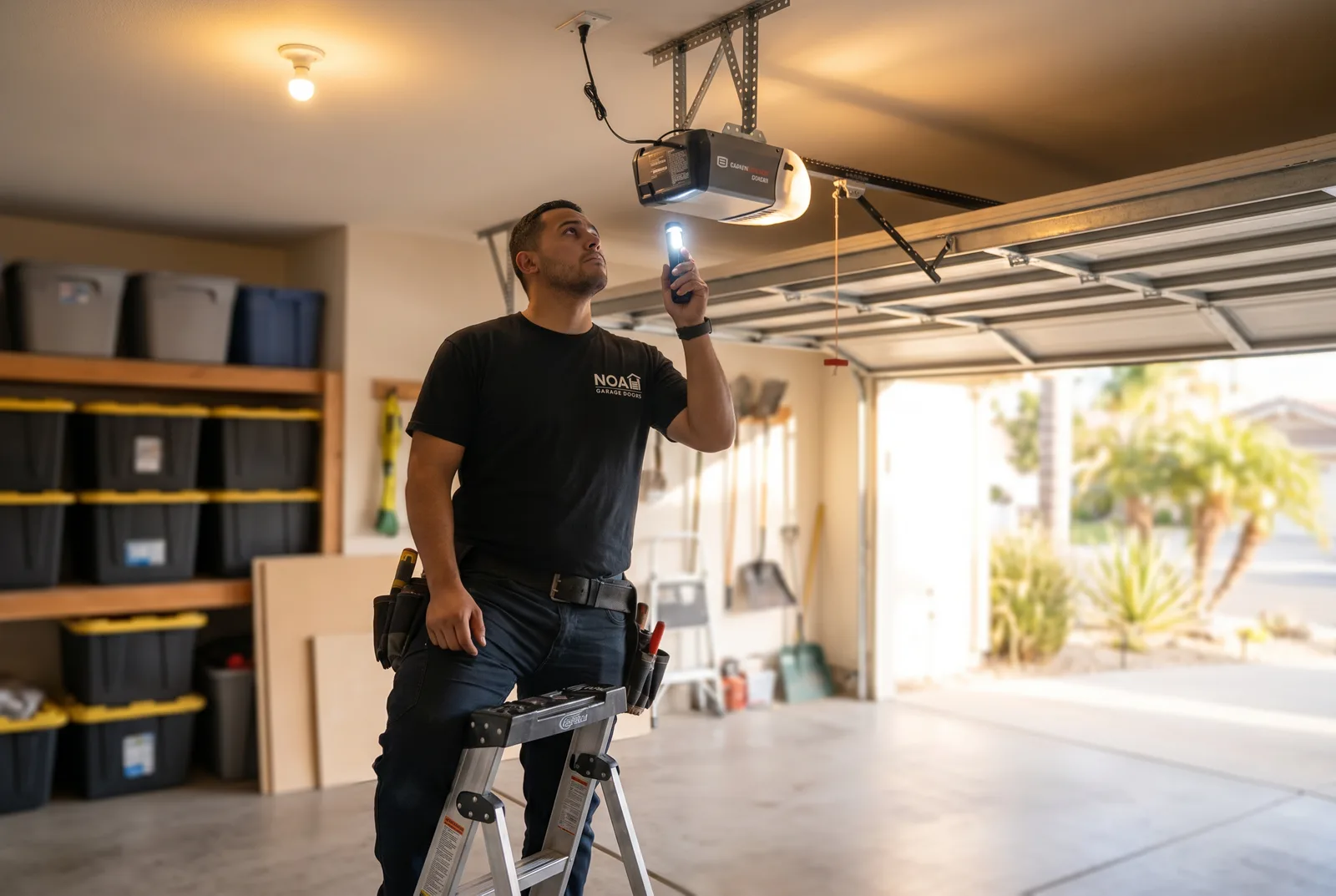
If your garage door opener hums but won't move, the motor has power and is running, but the mechanical link between the motor and the door has broken down. The most common causes are a broken spring, a stripped drive gear, a disconnected trolley, a locked door, or a failed start capacitor. Most have a clear, identifiable fix.
Press the remote on your garage door opener and hear a hum, but the door sits perfectly still. It is one of the most common repair calls we receive across San Diego County, from La Jolla and Poway to El Cajon and Escondido. The encouraging part: a humming opener almost always has a clear, identifiable cause and a straightforward fix.
This guide covers what the hum means, the seven most likely culprits, how to do a safe at-home check, and what repairs cost in San Diego in 2026. Read through before calling anyone: you may be able to resolve it yourself in under five minutes.
What the Hum Actually Tells You
When you hear the motor run but nothing moves, the opener is telling you two things at once: the motor has power and is turning, but the mechanical connection between the motor and the door has broken down somewhere.
That distinction matters. The problem could be inside the opener unit itself (a stripped gear, a dead capacitor, a worn motor), or it could be in the door hardware outside the opener (a broken spring, a snapped cable, a track obstruction). Identifying which zone the problem lives in tells you how serious it is and who can safely fix it.
Think of it like a car engine running in neutral: all the power is present, but nothing connects it to the wheels. Your job is to figure out where neutral got stuck.
Seven Common Causes Explained
The following causes account for nearly every humming-but-not-moving call we handle in San Diego. They are listed roughly in order of how often we encounter them.
1. Broken Torsion or Extension Spring
The most common cause by far. When a spring snaps, the door loses all counterbalance and can weigh 150 to 300 pounds. The opener motor hums but cannot generate enough force to lift it. Look for a visible gap in the coil above the door (torsion) or a broken coil along the side tracks (extension).
2. Stripped Drive Gear
Most belt-drive and chain-drive openers use a plastic drive gear that meshes with the motor. This gear strips over time, especially on units more than 8 to 10 years old. When it goes, the motor spins freely with a grinding hum but nothing turns the chain or belt.
3. Disconnected Trolley Carriage
Every opener has a red manual-release cord. If it was pulled accidentally (or by a child, or during a power outage), the trolley detaches from the drive rail and the motor runs without pulling anything. Re-engaging it takes about ten seconds.
4. Locked Door or Engaged Deadbolt
A manually engaged slide bolt or a turned handle lock stops the door cold. The opener hums against the lock and then shuts off. This is surprisingly common in homes where the garage also serves as a workshop or side entry, particularly in neighborhoods like Santee and Spring Valley where detached garages are common.
5. Failed Start Capacitor
The capacitor gives the motor an extra electrical kick to begin turning. When it fails, the motor tries to start, hums briefly, then cuts off. Capacitor failure is more common in coastal San Diego communities like Ocean Beach and Mission Hills, where salt air and humidity accelerate component wear inside the unit.
6. Snapped or Frayed Cable
The steel cables run from the bottom corner of the door up to the spring drum. A snapped cable lets one side of the door sag and bind in the track. The opener hums against the bind and stalls. A cable that has unwound partway creates the same effect. This job requires a professional: cables are under spring tension.
7. Thermal Overload Cutout
If the opener ran through many rapid open-close cycles (common when testing a new keypad or during a move), the thermal overload protector may have tripped. The motor hums, cuts off after a second, and refuses to run. Let the unit cool for 15 to 30 minutes and try again. If it works after cooling down, overheating was the answer. If it keeps overheating, the motor windings may be failing and replacement is likely the better path.
How to Diagnose the Problem at Home
Before calling anyone, run through this five-step check. It takes less than five minutes and costs nothing:
- Check the trolley disconnect. Look up at the rail running from the opener unit to the wall above the door. Find the red cord hanging from the trolley carriage. If the trolley is disconnected from the drive, pull the cord toward the door until you feel or hear a click. Try the opener again.
- Look for a locked door. Walk to the door and check both sides of the frame for a slide bolt, a keyed handle lock, or a manual deadbolt. Unlock anything you find and try the opener.
- Inspect the springs. Stand safely inside the garage. Look at the horizontal bar mounted above the door: that is the torsion spring. A broken spring shows a clear gap in the coil. Also look at the diagonal tracks above the door: extension springs run there and will hang loose or lie on the floor if broken. If a spring is broken, stop here and call a professional. Spring replacement under tension is not a safe DIY job.
- Check the cables. Crouch and look at both bottom corners of the door. A cable that is slack, unwound, or missing confirms a cable failure. Again, stop here and call a technician.
- Listen closely to the hum. A clean, brief hum that cuts off quickly points to a capacitor or thermal overload. A grinding or rattling hum that lasts longer points to a stripped gear. This distinction helps you describe the problem accurately when you call.
Repair and Replacement Costs in San Diego
What you pay depends entirely on the root cause. Here are the 2026 San Diego market rates for the most likely repairs. All prices are quoted before any work starts so there are no surprises.
| Problem | Typical Repair | Cost Range (2026) |
|---|---|---|
| Stripped drive gear or capacitor failure | Opener repair (parts + labor) | $125 to $350 |
| Motor failure or old unit (10+ years) | Opener replacement, installed | $450 to $950 |
| Single broken torsion spring | Spring replacement | $220 to $450 |
| Double spring or double-car door | Spring replacement | $380 to $650 |
| Snapped or frayed cables | Cable replacement (pair) | $150 to $300 |
A very common scenario we see around San Diego: a homeowner assumes the opener failed, but the real problem is a broken spring making the door too heavy to lift. The opener motor is fine. Once the spring is replaced, the opener runs perfectly again. This is why a proper diagnosis matters before replacing the unit.
If your opener is more than 10 to 12 years old and the motor itself is failing, replacement is usually the smarter choice. Newer openers include battery backup (now required by California law for new installations), quieter belt-drive motors, and smartphone connectivity. All replacement parts we install come with the manufacturer's warranty.
For anything other than a disconnected trolley or a locked door, Noah carries the most common gears, capacitors, and cables in his truck. Most repairs in Chula Vista, Oceanside, Carlsbad, and across the rest of San Diego County are completed on the same visit.
Frequently Asked Questions
The motor is receiving power and running, but something is blocking the transfer of motion to the door. The most common causes are a broken torsion or extension spring, a stripped plastic drive gear inside the opener, a disconnected trolley carriage, a locked door, or a failed start capacitor. A technician can identify the exact cause in minutes.
No. If a spring or cable has broken, forcing the door can cause it to drop suddenly or come off its tracks. Disconnect the opener using the red manual release cord and test whether the door moves freely by hand. If it does not lift easily or drops quickly, stop and call a technician.
It depends on the cause. Opener repair typically costs $125 to $350. If a broken torsion spring is the culprit, expect $220 to $450 for a single spring or $380 to $650 for a double spring or double-car door. Cable replacement runs $150 to $300 for a pair. We provide a firm quote after a free on-site assessment before any work begins.
Stand inside the garage and look at the horizontal steel bar mounted above the door (the torsion spring). A broken torsion spring will show a visible gap in the coil. For extension springs, check along the two tracks running above the door on each side. If a spring is hanging loose, has a clear break, or is lying on the garage floor, that is the cause.
Our Garage Door Services in San Diego
About Noah Garage Doors: Locally owned and operated, serving all of San Diego County. Call or text (619) 572-4266 or email Noahgaragedoors@gmail.com.