How Long Do Garage Door Openers Last?
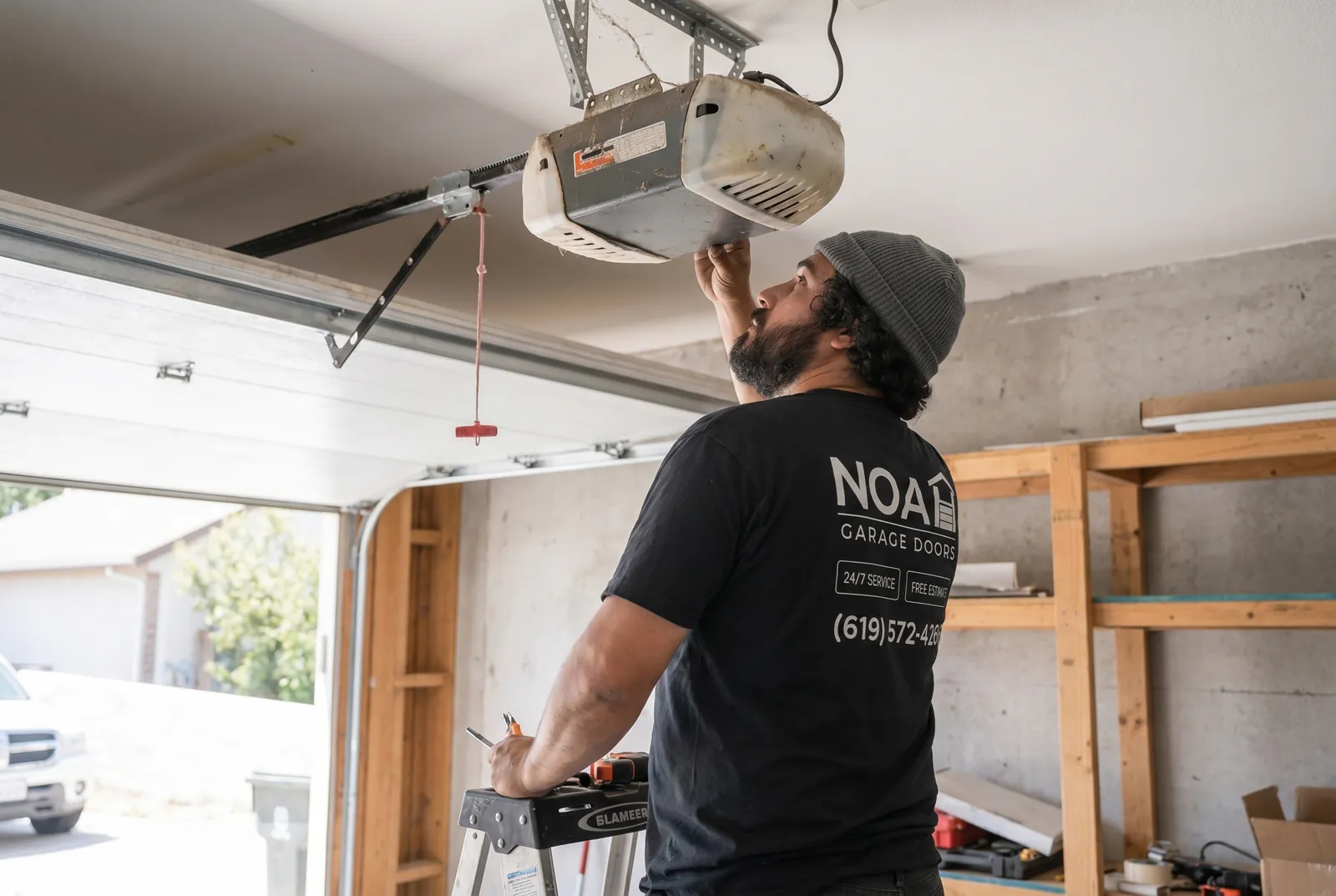
Your garage door opener is one of those appliances you stop thinking about the moment it works reliably, and can't stop thinking about the moment it doesn't. Most San Diego homeowners have no idea how old their garage door opener is until it starts acting up. Knowing the typical lifespan, and the signs that yours is nearing the end, can save you from a dead opener at the worst possible moment.
The short answer: most garage door openers last 10 to 15 years. But that range depends heavily on the drive type, how often the door cycles, how well the system is maintained, and in San Diego's case, how close the home is to the coast.
Average Lifespan of a Garage Door Opener
Industry data and real-world service experience point to the same window: 10 to 15 years for a typical residential opener. Here is how the main drive types compare in practice:
Chain Drive
The most common opener in San Diego. Robust and widely serviceable. Typically reaches 10 to 15 years with minimal maintenance. Noisier than belt-drive, but very reliable in detached garages.
Belt Drive
Quieter operation because a rubber belt replaces the metal chain. The belt itself can crack or stretch over time, but the motor unit often outlasts the belt. Lifespan: 10 to 15 years.
Screw Drive
Fewer moving parts, so less to wear out. Handles temperature swings well, though San Diego's mild climate makes that advantage less critical. Comparable lifespan to chain and belt.
Wall-Mount (Jackshaft)
Mounts on the wall beside the door rather than overhead. Premium build quality means these units often reach 15 years or more. Common in Mission Hills and Hillcrest homes with compact garages.
The door itself matters too. An opener paired with a door that is out of balance, has worn springs, or has corroded rollers works harder than it should on every cycle. That extra load shortens the motor's life. If your opener is aging, having the door inspected alongside the opener is worthwhile.
How San Diego's Climate Affects Openers
San Diego's temperate climate is generally easy on mechanical systems, but the marine layer tells a different story for homes near the coast. Neighborhoods like Ocean Beach, Pacific Beach, Point Loma, La Jolla, and Coronado all experience regular salt air exposure that accelerates corrosion on metal components.
Circuit boards are particularly vulnerable. The logic board inside a garage door opener controls everything from motor speed to safety reversals. When salt-laden humidity works its way into the motor housing over years of exposure, trace corrosion on the board can cause intermittent failures that are easy to mistake for a remote or sensor problem. By the time the board fails completely, it may be more expensive to source a replacement part for a discontinued model than to replace the opener outright.
Inland San Diego neighborhoods, including Poway, Rancho Bernardo, El Cajon, and Santee, face a different climate challenge: summer heat. Temperatures in these areas regularly exceed 95 degrees during heat events, and an enclosed garage can reach significantly higher. Heat degrades rubber components like the belt and the bottom seal on the door itself, and it puts more stress on the motor when the door is heavy or slightly out of balance.
The upshot: San Diego homeowners within a mile or two of the ocean should plan for the lower end of the 10-to-15-year range and schedule annual maintenance. Those inland have a bit more margin but should not skip maintenance either.
Warning Signs Your Opener Is Failing
A garage door opener rarely fails without warning. Here are the signals to watch for:
- Slow or delayed response. The door takes a few extra seconds to respond after you press the remote. This can indicate a weakening motor or a logic board starting to degrade.
- Grinding or scraping from the motor head. The drive gear inside chain and belt-drive openers is a plastic component that wears over time. Grinding often means the gear is stripping. A gear replacement runs $125 to $350. If the motor itself is the issue, replacement becomes more economical.
- The motor runs but the door doesn't move. The trolley carriage may have disconnected from the drive mechanism, or the drive gear is fully stripped. A technician can diagnose this quickly.
- Intermittent operation. The door opens on one press and ignores the next three. After you rule out dead remote batteries and a blocked sensor beam, this pattern usually points to a failing logic board or a loose wiring connection.
- Visible rust or corrosion on the rail or motor housing. Surface rust on the rail is cosmetic and manageable with lubrication. Corrosion inside the motor housing is a more serious sign of internal damage.
- The opener lacks auto-reverse or battery backup. Auto-reverse is a safety requirement that causes the door to stop and reverse when it contacts an object or person in its path. Battery backup lets the door operate during a power outage, a California legal requirement for new installations since 2019. An opener without these features is both a safety liability and a compliance issue.
Repair vs. Replace: How to Decide
Not every problem requires a new opener. Here is how to think through the decision:
| Situation | Recommended Action | Typical Cost (2026) |
|---|---|---|
| Single component failure, opener under 10 years old | Repair | $125 to $350 |
| Opener repair on a unit over 10 years old | Evaluate: if repair cost approaches $250+, replacement is often smarter | $125 to $350 (repair) or $450 to $950 (replacement) |
| Opener lacks auto-reverse or battery backup | Replace | $450 to $950 |
| Parts discontinued for the model | Replace | $450 to $950 |
The general rule: repair when the opener is under 10 years old and a single, identifiable component has failed. Replace when the unit is over 12 years old, repair costs are significant, or the opener lacks current safety features. A new opener comes with a manufacturer's warranty on parts and gives you a reliable starting point for another decade or more.
How to Extend Your Opener's Lifespan
The single most effective thing you can do for your garage door opener is to keep the door itself in good shape. The opener is only as reliable as the door it moves. Here is what that looks like in practice:
- Lubricate the door's moving parts twice a year. Apply a silicone or lithium-based lubricant to the rollers, hinges, and springs. Do not use WD-40 on these components, it attracts dust and dries out quickly. A well-lubricated door requires significantly less force from the opener motor on every cycle.
- Test the door balance annually. Disconnect the opener by pulling the red emergency release cord, then manually lift the door to waist height and let go. It should stay in place. If it drops or flies up, the springs are out of adjustment and the opener is compensating, which shortens its life. Have a technician re-tension the springs.
- Keep the photo-eye sensors clean and aligned. The safety sensors sit at the base of the tracks on each side of the door. Dust, cobwebs, or a bump from a bicycle can knock them out of alignment or block the beam, causing the opener to reverse every time. Wipe the lenses monthly and verify the indicator lights are solid.
- Schedule a professional tune-up and safety inspection once a year. A technician will check spring tension, cable condition, roller wear, sensor alignment, and the opener's force and travel limit settings. Catching a worn cable or a loose hinge before it causes a failure is far cheaper than an emergency repair.
- Address coastal corrosion proactively. If your home is near the coast in areas like La Jolla or Ocean Beach, consider applying a corrosion-inhibiting lubricant to the rail and motor housing once a year. It is a five-minute task that meaningfully extends the life of exposed metal components.
For homeowners whose opener is already showing signs of failure, particularly in the middle of the night or on a weekend, 24/7 emergency garage door repair is available throughout San Diego County. Noah Garage Doors operates around the clock so a failed opener does not strand you at home or leave your garage unsecured.
Frequently Asked Questions
Most garage door openers last 10 to 15 years. In San Diego's coastal neighborhoods like La Jolla, Point Loma, and Ocean Beach, salt-laden marine air can accelerate corrosion on circuit boards and drive mechanisms, potentially shortening that window. Routine lubrication and annual maintenance help any opener reach or exceed the upper end of its expected lifespan.
Key warning signs include slow or delayed response to remote commands, the motor running but the door not moving, grinding or scraping noises from the motor head, intermittent failures even after remote batteries are replaced, and visible damage to the drive gear or trolley carriage. An opener older than 12 years that lacks auto-reverse or battery backup is also a strong candidate for replacement.
A new garage door opener, professionally installed, costs $450 to $950 in San Diego. Opener repair, when a single component can be fixed rather than the whole unit replaced, runs $125 to $350. The final price depends on the drive type, motor horsepower, and features such as Wi-Fi connectivity and battery backup.
Yes. The marine layer, salt air, and humidity common in coastal San Diego neighborhoods accelerate corrosion on exposed metal components and circuit boards. Homeowners in areas like Pacific Beach, Ocean Beach, and Coronado should lubricate opener hardware more frequently and schedule annual maintenance inspections to catch salt-related wear before it causes a failure.
Our Garage Door Services in San Diego
About Noah Garage Doors: Locally owned and operated, serving all of San Diego County. Call or text (619) 572-4266 or email Noahgaragedoors@gmail.com.