California Battery Backup Law for Garage Door Openers
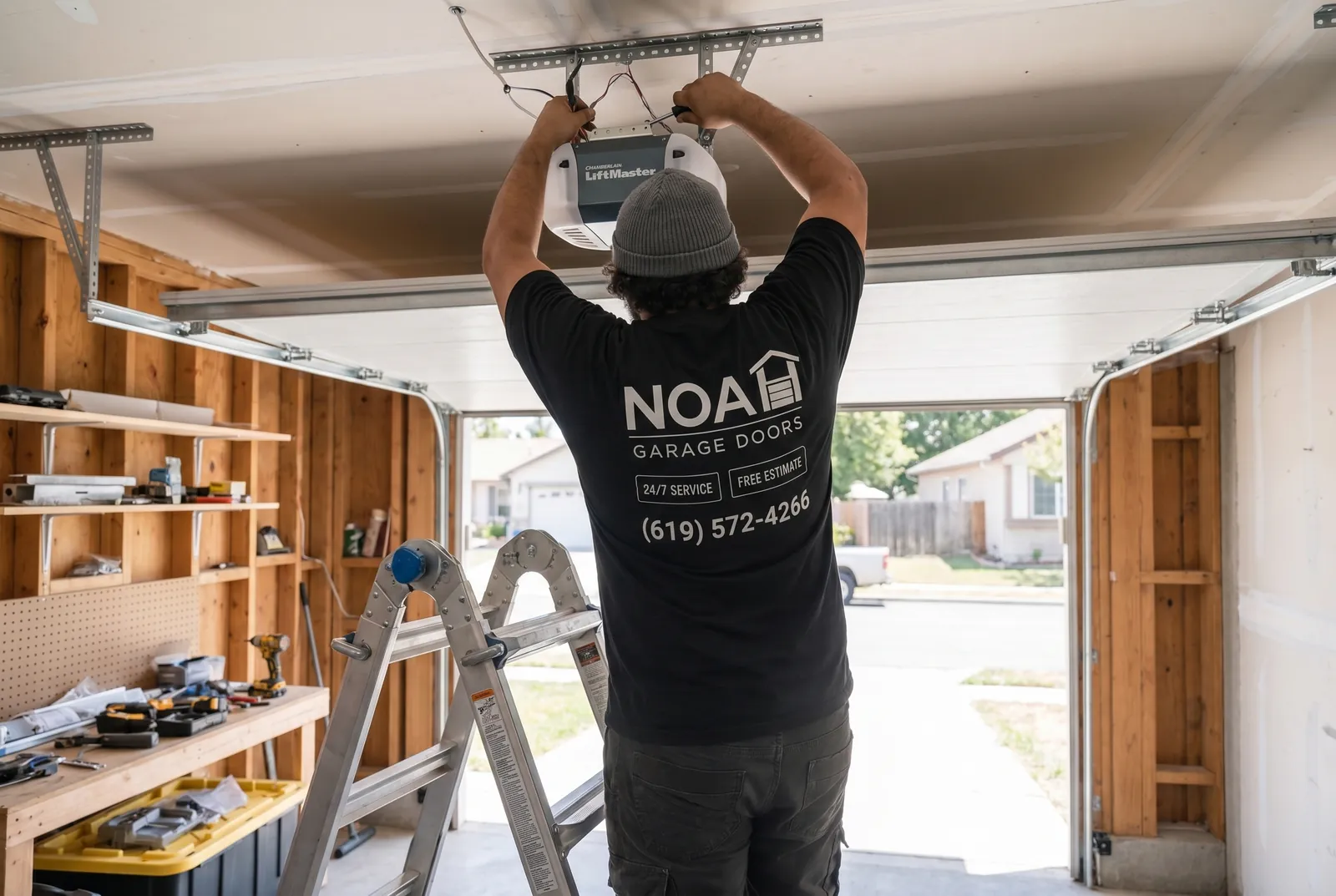
California Assembly Bill 1738 (AB 1738), signed into law in 2019 and effective July 1, 2019, requires all new residential garage door openers sold or installed in California to include a battery backup unit. For San Diego homeowners, this law is directly relevant: San Diego County experiences more declared wildfire emergencies than almost any county in the state, and the Public Safety Power Shutoff (PSPS) events that accompany those threats have left hundreds of thousands of households without electricity for days at a time.
If you are buying a new opener or replacing an aging one, understanding this law tells you what to look for, what questions to ask, and what the job should cost. If you have an older opener that predates 2019, the law does not force you to act, but the case for upgrading is stronger in San Diego than in almost any other California county.
What AB 1738 Requires
The law has two core requirements for any new residential garage door opener sold or installed in California on or after July 1, 2019:
- Built-in battery backup: The opener must include a battery backup unit capable of operating the door when utility power is unavailable.
- Minimum cycle capability: The battery must be able to complete at least two full open-and-close cycles during a power outage.
These requirements apply to the opener itself, not to the door or tracks. The law covers the motor unit, meaning any new opener sold through a retailer or installed by a contractor in California must meet the standard. Manufacturers responded by incorporating battery backup modules directly into their residential product lines, so most compliant openers from LiftMaster, Chamberlain, and Genie now include backup capability as a standard feature rather than an optional add-on.
Who the Law Affects
AB 1738 applies specifically to new openers. It does not require homeowners with existing openers to retrofit or replace them. If your garage door opener was installed before July 1, 2019, you are not out of compliance by keeping it. The law targets the point of sale and installation, creating a baseline that ensures every new opener entering the California market meets the backup standard.
That said, there are practical situations where the law touches you even with an older opener:
- If you hire a contractor to replace your opener, they are required to install a compliant unit. They cannot legally install a new opener without battery backup in California.
- If you purchase an opener through a retailer and install it yourself, that opener must also comply. Non-compliant openers should not be sold in California, but shoppers buying online should verify compliance before purchasing a unit from an out-of-state retailer.
- If your current opener fails and needs replacement, the replacement will automatically be compliant because no non-compliant new openers can legally be sold in the state.
Why It Matters in San Diego
San Diego is one of the highest-risk counties in California for wildfire-related power shutoffs. Neighborhoods from Alpine and Lakeside in the east to Rancho Bernardo and Scripps Ranch in the north have experienced multi-day PSPS events that cut power without warning. During the 2018 Camp Fire in Northern California, residents in areas without power were unable to open their electric garage doors manually fast enough to evacuate. AB 1738 was written specifically to address that scenario.
In San Diego County, the risks are compounded by our local climate. The coastal marine layer brings high humidity to neighborhoods like La Jolla, Mission Hills, and Ocean Beach, while the inland valleys around El Cajon and Santee experience dry, hot conditions that increase fire risk every autumn. When a red-flag warning triggers a PSPS event, power can go out across entire ZIP codes. Battery backup means your door stays operable for emergency egress even when the grid is down.
Beyond wildfires, San Diego sees occasional winter storms, transformer failures, and rolling blackouts during heat events. Any of these can cut power to your opener. The battery backup keeps your daily routine uninterrupted: you can still get your car out for work in the morning even when your block is dark.
What Battery Backup Actually Does
A battery backup unit in a compliant opener is a rechargeable battery, usually lithium-ion or lead-acid, that stays charged while you have utility power and takes over automatically the moment power is lost. The transition is seamless: you press your remote or wall button, the door moves, and you may not even notice the power is out until you see the lights are off.
California's minimum requirement is two full cycles, but most manufacturers exceed that considerably. Current compliant models from major brands can typically complete 20 or more open-and-close cycles on a full charge, which is more than enough for most outage scenarios. Battery capacity also varies by model, so if you live in an area prone to extended outages, asking about cycle count before buying is worthwhile.
Battery lifespan is a practical consideration too. Most backup batteries last two to five years before their capacity degrades enough to warrant replacement. Some openers display a warning light when the battery is low; others require you to test manually. A tune-up and safety inspection is a good time to have the battery tested as part of a broader checkup on your opener's operation.
Automatic Activation
Battery backup engages instantly when power is cut, with no manual switch or reset required.
LED Operation Light
Most battery-powered operation modes activate an LED on the opener to provide light in the garage during the outage.
Full Remote Compatibility
Your existing remotes and keypads continue to work normally while the opener is running on battery.
Battery Replacement
When the backup battery ages out, it can be replaced without swapping the full opener unit.
Cost of a Compliant Opener in San Diego
Because battery backup is now standard on all new openers in California, you are not paying a premium for a special model. Any new residential opener a contractor installs will include it. The price range depends on the drive type, horsepower, and smart-home features:
| Service | San Diego Cost Range (2026) | Notes |
|---|---|---|
| Opener replacement, including installation | $450 to $950 | Includes battery backup as standard; price varies by drive type and features |
| Opener repair (existing unit) | $125 to $350 | Repair before replacement if the opener is otherwise functional |
| Battery replacement (backup module only) | Quoted after assessment | Cost varies by opener model; not all batteries are the same size or voltage |
| Tune-up including opener inspection | $99 to $199 | Includes battery test, safety sensor check, and lubrication |
If your existing opener is otherwise in good shape but lacks battery backup, the first question is whether your model accepts an external battery backup add-on module. Some older LiftMaster and Chamberlain models do, and adding a module can be significantly less expensive than full replacement. A technician can tell you after a quick assessment whether your unit is compatible. For openers more than ten years old, replacement is usually the more cost-effective path: newer units are quieter, more energy-efficient, and include smart-home connectivity that older models lack.
Frequently Asked Questions
California Assembly Bill 1738, effective July 1, 2019, requires all new residential garage door openers sold or installed in California to include a battery backup unit. The backup must be capable of opening and closing the door at least two complete cycles when the power is out. The law was passed in response to the 2018 Camp Fire, when power outages prevented some residents from opening their garage doors to evacuate.
No. AB 1738 only applies to new garage door openers sold or installed on or after July 1, 2019. If your existing opener was installed before that date, you are not required by law to replace or retrofit it. However, adding battery backup to an older opener or replacing it with a compliant unit is worth considering, especially in San Diego County where Public Safety Power Shutoff events and wildfire-related outages can cut power with little notice.
California law requires the backup to complete at least two full open-and-close cycles. Most compliant openers from major manufacturers exceed that minimum and can complete 20 or more cycles on a full charge. Battery backup units typically maintain a usable charge for 12 to 24 hours during a short outage. Battery life decreases over time; most manufacturers recommend replacing the battery every two to five years.
Garage door opener replacement, including installation, runs $450 to $950 in San Diego for a standard residential unit with battery backup built in. The exact cost depends on the drive type (belt, chain, or wall mount), horsepower rating, and any smart-home or Wi-Fi features you select. If you want to add battery backup to an existing compatible opener rather than replacing the whole unit, a technician can quote the cost after a free assessment, since not all older models accept an add-on backup module.
Our Garage Door Services in San Diego
About Noah Garage Doors: Locally owned and operated, serving all of San Diego County. Call or text (619) 572-4266 or email Noahgaragedoors@gmail.com.